

TOP NOTES - EPISODE 2: Five Lobby Bars Worth Crossing the World For

The Heartbeat of a Hotel
There is a room in every great hotel where the property reveals itself.
Not the suite.
Not the restaurant.
Not the spa.
The lobby bar.
It is the emotional centre of the building — the place where arrivals soften into presence, where departures linger a little longer than planned, and where strangers briefly share the same atmosphere before continuing on separate journeys.
Designers often speak about materials, lighting, and flow. Operators talk about service and programming. But the true measure of a lobby bar is something harder to quantify: how it makes you feel when you sit still long enough to notice.
These are five lobby bars worth crossing the world for — not for the drinks alone, but for the atmosphere they hold.
1/The Connaught Bar — London
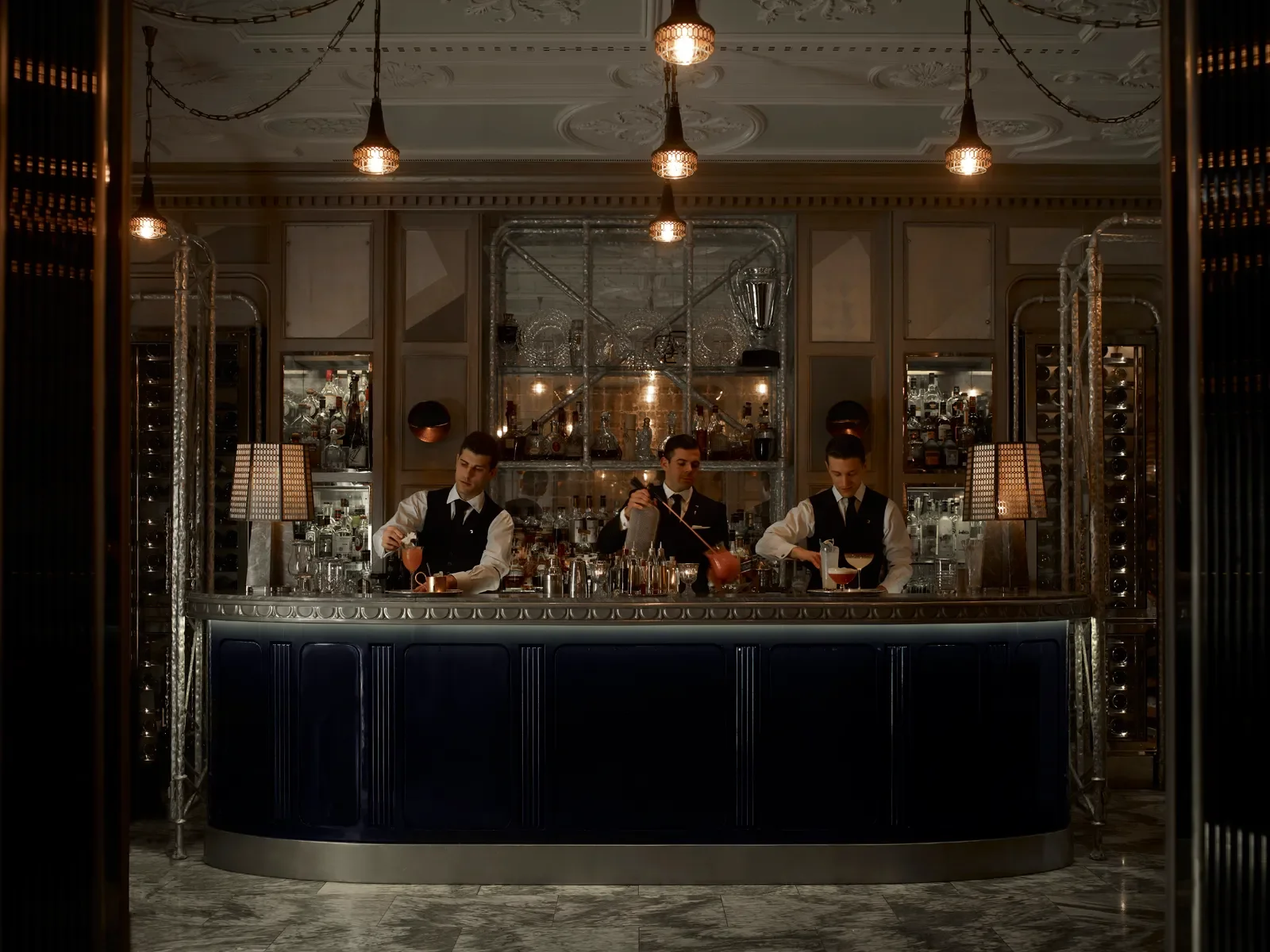
Stepping into The Connaught Bar is less like entering a venue and more like crossing a threshold into composure.
Outside, Mayfair moves with quiet urgency. Inside, time becomes deliberate.
Everything in the room feels measured — from the geometry of the walls to the choreography of service. Conversations lower themselves instinctively, as if the space is guiding behaviour without instruction.
It is a masterclass in restraint.
Many hotels attempt to create calm. Few achieve it with such precision. The Connaught Bar does not overwhelm you with identity; it steadies you until you find your own centre again.
2/Bar Hemingway — Paris
If The Connaught is restraint, Bar Hemingway at the Ritz Paris is intimacy.
Tucked deep within the hotel, it feels less like a public space and more like a private study that guests are quietly permitted to share.
The room carries its history lightly — leather softened by time, photographs that feel discovered rather than curated, the faint sense that stories linger in the air long after their owners have left.
You don’t come here to observe the world.
You come here to withdraw from it.
Some spaces preserve history. Others simply continue it. Bar Hemingway belongs to the latter.
3/King Cole Bar — New York
New York does not slow down for anyone, and its great hotel bars don’t attempt to change that. They absorb the city’s momentum and refine it.
The King Cole Bar at The St. Regis sits at the intersection of business, society, and spectacle. Beneath the famous mural, conversations unfold with purpose. Meetings blur into social occasions, and social occasions quietly return to business again.
There is a confidence to the room — not loud, not performative, simply assured of its place in the city’s rhythm.
Where some lobby bars offer escape, this one offers alignment. You leave feeling more attuned to New York rather than shielded from it.
4/American Bar — The Savoy, London
Some rooms belong not to a city, but to travel itself.
For more than a century, the American Bar at The Savoy has welcomed the world’s arrivals — royalty, performers, first-time visitors, seasoned travellers who know exactly where to sit without being guided.
It is a room shaped by continuity.
Generations have passed through these doors, each bringing their own stories and leaving traces behind. The effect is subtle but unmistakable: you feel part of something ongoing, not temporary.
In an era where hospitality often chases novelty, the American Bar demonstrates the quiet power of permanence.
5/Atlas — Singapore
Atlas does not whisper. It declares.
Towering ceilings, Art Deco grandeur, and a sense of theatrical scale create a space that feels almost cinematic. You don’t lean in to speak here; you look up, absorbing the magnitude of the room before orienting yourself within it.
It is a reminder that hospitality can still astonish — that a hotel can offer spectacle without sacrificing refinement.
Where some lobby bars soothe and others anchor, Atlas elevates. You leave with a sharpened awareness of place, as though the room has briefly altered your sense of proportion.
Why would I share this?
I happen to love a great lobby bar - it’s not an amenity. It’s infrastructure for emotion.
It shapes first impressions, anchors identity, and provides a stage for the countless small interactions that define a stay long after checkout. Guests may not remember the thread count of the sheets or the exact layout of the suite, but they remember how a hotel felt when they first sat down and allowed themselves to arrive.
For those of us who design atmosphere — through scent or otherwise — these rooms offer the clearest insight into a property’s intentions. Every decision converges here: lighting, materials, sound, service, and the invisible elements that complete the experience.
Spend enough time in great lobby bars and patterns begin to emerge. The best ones do not try to impress you immediately. They allow you to settle, to observe, to become part of the room rather than merely passing through it.
Next time you travel, resist the instinct to head straight for the lift.
Sit for a while.
Watch the choreography of arrivals and departures. Notice how the atmosphere shifts as the evening deepens. You may discover that the true identity of a hotel is not hidden in its suites at all, but beating quietly at its centre.